
Running Injury Physiotherapy Sydney CBD: Rehabilitation and Return to Running
A running injury rarely improves through random rest followed by an immediate return to the same training. The practical solution is to identify the injured or overloaded tissue, reduce the aggravating dose, maintain useful fitness, and progressively restore strength and running load.
Body Clinic Sydney has combined physiotherapy, manual therapy, specific rehabilitation and physio-led personal training for more than 10 years. This integrated approach allows us to manage pain while rebuilding the physical qualities required for a durable return to running.
When a running injury should be assessed
Assessment is appropriate when pain changes your gait, worsens from run to run, persists during walking, causes swelling, or repeatedly returns whenever distance or speed increases. Seek prompt medical review for inability to bear weight, major trauma, marked swelling, calf swelling with shortness of breath, neurological symptoms, or suspected bone stress injury.
Night pain, focal bone tenderness and pain that progresses from running to walking require particular caution. Bone stress injuries need early recognition and an appropriate return-to-impact plan.
Common running presentations
Running-related pain may involve the patellofemoral joint, Achilles tendon, calf, plantar fascia, hamstring, gluteal tendons, iliotibial region, ankle or bone. The same symptom location can have different causes, so diagnosis should not be based on an online list alone.
A frequent trigger is a rapid change in weekly distance, hills, speed work, racing, surface or footwear. The body adapts to load, but adaptation takes time. Training increases that outpace tissue recovery can exceed current capacity.
What a running physiotherapy assessment includes
Onset, location and behaviour of pain
Recent changes in distance, intensity, hills and frequency
Walking, hopping and impact tolerance
Calf, quadriceps, hamstring and hip strength
Ankle, knee and hip movement where relevant
Running gait when it is likely to change management
Sleep, recovery, nutrition and previous injury
Race goals and the time available to prepare
Not every runner needs a complex gait analysis or scan. Testing should answer a clinical question. Imaging is appropriate when fracture or bone stress is suspected, trauma is significant, or the result will materially alter management.
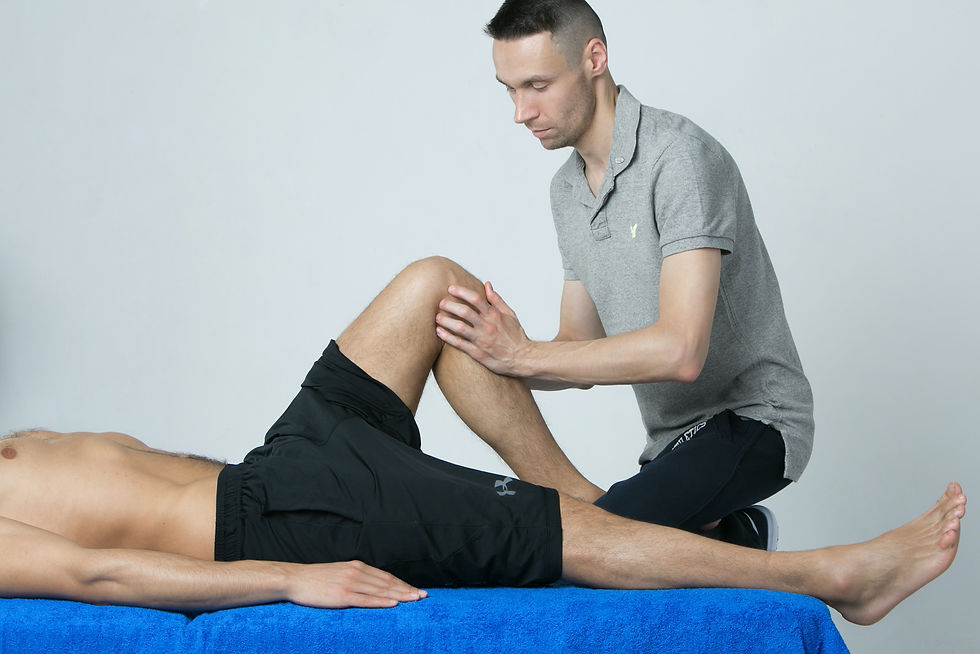
Manual therapy for pain and movement
We use manual therapy extensively when pain or stiffness is preventing normal movement and rehabilitation. Joint mobilisation, soft-tissue treatment and hands-on techniques improve ankle, knee or hip movement and reduce symptoms allowing a faster return to loading.
Strength training is essential for many runners
Running itself is repetitive and does not always provide enough targeted strength stimulus to address a capacity deficit. Depending on the injury, rehabilitation may include:
Heavy calf and soleus strengthening
Quadriceps loading through knee extension, leg press and squats
Hip and hamstring strengthening
Single-leg step-up and split-squat variations
Foot and ankle work where indicated
Hopping, landing and plyometric progressions
Specific loading supports muscle, tendon and connective-tissue adaptation. Tendons often require progressive resistance over time; a collection of light stretches is rarely sufficient for returning to fast or long running. Later rehabilitation should prepare the runner for impact, elastic loading, hills, speed and fatigue.
Should you stop running completely?
Sometimes a short period away from running is necessary, particularly with suspected bone stress injury or pain that substantially alters gait. In other cases, the runner can continue at a modified dose.
Options include decreasing distance, removing speed work or hills, increasing recovery days, using run-walk intervals or temporarily substituting cycling or pool running. The goal is to find the highest tolerable training dose while the injured tissue is progressively strengthened.
A useful monitoring approach considers pain during the run, gait quality, symptoms later that day and the next morning. If the response escalates across sessions, the load is too high.
A staged return-to-running plan
Return begins when walking and basic loading are sufficiently tolerated. A typical progression may move from brisk walking to short run-walk intervals, then increase continuous duration before adding hills and speed. Only one major variable should increase at a time.
Calendar-based rules are less useful than criteria. Strength, hopping tolerance, symptoms and recovery should guide progression. Race deadlines do not change tissue biology, so the plan must balance ambition with the available preparation time.
Physio-led personal training for runners
Our physio-led personal training gives runners a structured strength program alongside their return-to-running plan. For more than 10 years, Body Clinic Sydney has coordinated manual therapy, rehabilitation and performance training so runners do not stop care at the point where pain first settles.
Learn more about our Physiotherapy service and our Sydney CBD Clinic.
Related Body Clinic Sydney resources
Frequently asked questions
Can I run through pain?
Sometimes mild stable symptoms are manageable, but pain that changes gait, worsens during the run or escalates across sessions requires modification and assessment.
Will stretching fix a running injury?
Not usually by itself. Mobility may be relevant, but many running injuries require load management and specific progressive strengthening.
How quickly should mileage increase?
There is no universal safe percentage. Progress depends on the injury, current tolerance, training history, intensity and recovery.
Book a running injury consultation in Sydney CBD
If pain is interrupting your running, we can assess the problem and build a clear rehabilitation and return-to-running plan.
Complete the enquiry form below, call 0410 148 296 or email nigel@bodyclinicsydney.com. Body Clinic Sydney is inside SOHO Gym at 2 Bligh Street.
References and further reading
This article provides general information and does not replace individual medical or physiotherapy advice.


Comments